
Escaping the Funk
Fiction by Ruben Reyes Jr., Yaa Gyasi, and sam sax

First, a confession: this month, it took six books for me to get to the three I’m sharing with you (hence the later-than-usual post). Of the three I abandoned, two were novels I picked up with great excitement and reluctantly DNFed in frustration, when it dawned on me that no one was actually making me finish them. The third I only finished because I still felt vaguely guilty about bailing on the other two.
What was odd about this to me was how glowingly reviewed these books are in general: mostly “raves” on Lit Hub Book Marks, which tracks professional reviews across a number of newspapers and websites. Still, buried in the one- and two-star Goodreads reviews I found the catharsis of a handful of other readers whose reactions more or less echoed my own. What I appreciated most about these reviews is that they did not seem fundamentally unkind or derisive in nature. These readers, like me, were fans of the writer’s other work, or believed themselves to be ideal readers for these books based on their descriptions. These readers, like me, had hoped to like these books and were grieved by their disappointments, not gloating in them.
To be fair, sometimes a negative reaction to a book reflects more on my state of mind and what I need out of a book at a given moment than on the book itself, but it got me to thinking: what is it that makes a book satisfying?
A few years ago, I had the opportunity to hear Nicole Terez Dutton, the editor-in-chief of the Kenyon Review, give the best answer I’ve ever heard to this question: what do you look for in a story? She said something to the effect of: she looks for a story to do at least two, maybe even three things, that interact with each other. This wording is vague, but perfect—whatever a narrative sets out to do, it’s always more satisfying when there are multiple angles at work, and they converge in some way. And Dutton’s criteria fits these three books, which each felt deeply refreshing.
Without further ado, here they are!
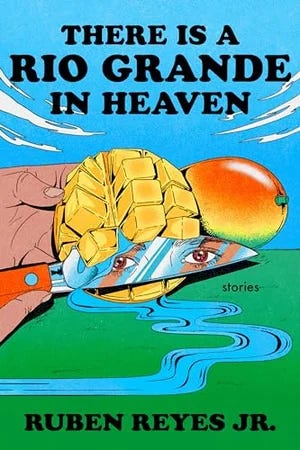
There is a Rio Grande in Heaven by Ruben Reyes Jr.
It was the opposite of the clutter his parents kept at their home when he was growing up, the kind that accumulates when ghosts from the third world prevent you from throwing anything away. - from “He Eats His Own”
This speculative debut story collection about Salvadoran immigrant experiences is one of the most purely enjoyable collections I’ve read in a long time. It’s worth noting that I read it on the tiny screen of my ancient iPhone SE, which I’ll admit is not really the ideal format, especially because the last long story, “Variations on Your Migrant Life,” is effectively a “Choose Your Own Adventure” story, meaning I had to keep flipping back and trying different possibilities before I became confident that I’d exhausted all the narrative options. Even with that technical disadvantage, this was the book that sparked my recovery from my funk and got me excited about reading again.
Influenced by Ray Bradbury’s science fiction, these stories are not as character-driven as I usually go for; instead, they are far more plot- and concept-driven. The concepts tend to be absolutely brilliant and thought-provoking, which more than compensates for the occasional underdeveloped character. In “Try Again,” a gay man pays for an AI-robot version of his late father in the hopes of trying to have a better relationship with the robot version. Another story takes place in a world where Americans are sent to detention centers on Mars, while yet another features an abuela who literally turns into a puppet. A particular standout in the collection for me was “The Myth of the Self-Made Man,” about a PhD student in the semi-distant future searching the archives for a contemporary first-person account of a cyborg household servant named Felipe. I appreciated the moral inquiries embedded in so many of these stories, especially “He Eats His Own,” where Neto, a wealthy Salvadoran-American character exploits his family members in an elaborate and expensive plot to ship fresh mangoes to him daily via commercial flights to Los Angeles. These longer, more traditionally shaped stories are interspersed with a series of short pieces all titled “An Alternate History of El Salvador or Perhaps the World,” each of which delivers a different brief alternate history as promised. There’s also a lovely whiff of satire throughout the stories, a bit like Tony Tulathimutte’s Rejection, though lighter in its touch.
(Bonus: Reyes Jr. also has a new story out in the latest issue of American Short Fiction called “You Did a Bad Thing,” which I enjoyed and recommend checking out as well if any of this piques your interest. It has a similarly fantastic premise—a woman works for a subscription service wherein people pay to have their online activities monitored and be alerted when they commit moral or social errors.)
‘In my dreams I kept seeing this castle, but I did not know why. One day, I came to these waters and I could feel the spirits of our ancestors calling to me. Some were free, and they spoke to me from the sand, but some others were trapped deep, deep, deep in the water so that I had to wade out to hear their voices…When they were living they had not known where they came from, and so dead, they did not know how to get to dry land. I put you in here so that if your spirit ever wandered, you would know where home was.’
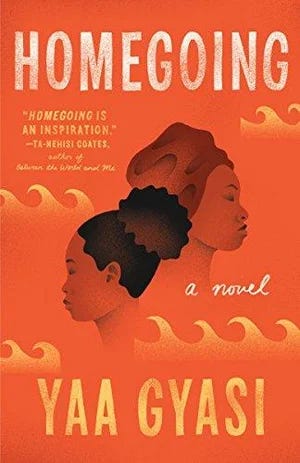
Fresh off There is a Rio Grande but still feeling like my reading momentum was tenuous, I turned to Yaa Gyasi’s Homegoing next, which several people have strongly recommended to me over the years because of my interest in historical fiction. They were right—it’s an excellent novel. I now recommend it to you!
The structure is highly unusual and beautifully executed, almost like a novel-in-stories. The book begins on the Gold Coast, in what is now known as Ghana, with the twinned stories of two half-sisters whose lives take radically divergent paths. One is kidnapped and sent to the U.S. on a slave ship, while the other marries one of the white men who helps run the Castle, in which the other sister is imprisoned prior to her transatlantic journey. Each chapter that follows adds the story of a new character in this family tree, moving forward in time with each generation. While some readers will be frustrated by the fact that this structure means we can never return to these threads, the subsequent chapters do provide glimpses of characters later in their lives, or offer other clues as to what happened to them. As with Jenny Erpenbeck’s book The End of Days (which I covered in March), I really loved the effect of this—the visceral awareness it gives of what is lost over time.
I also appreciate how Gyasi engages with the complexities of African versus African-American identities in the U.S. and reflects on the long-term consequences of the transatlantic slave trade on individuals and families from the perspectives of Fante and Asante characters, some of whom are complicit in the enslavement of people from other tribes, and others of whom are enslaved and displaced from their homelands. The book sheds light on aspects of these histories I have not seen explored elsewhere. Gyasi finds an unexpectedly resonant way to pull all the threads together in the end as well.

I tried to make my life what I hoped death might look like, a weighted blanket, the arms of a comforter wrapping around you as you watch your own story unfold across a screen outside of you. But, of course, I realize now, death is quite the opposite. It is reliving all of it, the fog become sentient, whatever’s left, feeling every inch of the needle work its way in, then out again, and then back in. The mark you leave on the world, left forever in you.
The last of the three I also read on my tiny phone screen, which in this case might have been an ideal way to experience this novel, as it takes the form of poetic narrative fragments, often only one or two pages each. Nonlinear narratives can be very hit-or-miss in my book, but this one found the sweet spot for me, with enough cohesion to pull me along. The book is essentially the fragmented memories of the life of the protagonist, plus some dreams or perhaps invented stories of their own mixed in (including some historical interludes set (I think) in the villages of their Jewish ancestors) as they flash through their mind after they set themselves on fire in political protest. It’s set during the first Trump administration and focuses on a character questioning the point of their life, the point of protesting, the way their own life fits into a much larger history.
Though the concept is heavy, the mood of the book is not. It’s intense, but it’s also beautiful, full of questions and wonder and bewilderment. One of my favorite moments is when the protagonist passes a goat on the way to the subway—on their way to their self-immolation—and captures something essential to what it’s like for so many of us to be alive in these strange times, the way a city crowd might calmly accept the unexplained presence of a goat, one individual at a time: “All I’ve ever wanted is to belong somewhere, and all I can ever feel is how out of place I likely appear. So, in this spirit, I too walk past the goat as if it were a normal part of the landscape; I too accept what is in front of me and what is to come as I head down the subway steps.” So much of what it means to be alive right now is captured in that choice to accept a truly incongruous goat as just part of the scenery.
The language at the line level is spectacular—no surprise that sam sax is a poet—but what really got me about this book was the sharpness of its insights. I bookmarked so many passages as I read because they said something true that I hadn’t seen articulated anywhere else or quite so memorably. I’ll leave you with this one, which I see as a kind of thesis for the book—resisting that horizon of the unimaginable through story:
The horizon, not unlike death, is the point beyond which all perception fails, the other side of which is unimaginable. When up on deck someone at last calls out land, I know this is what they must mean. Look there, brethren, behold off in the distance, there lies the limits of our imagination.
By the by, with getting this post out a bit late, I will likely wait until later in June to post again before I take my usual summer hiatus for July and August.
Until next time, thanks as always for reading!